Introducing the First Headless Analytics Agent
nao is becoming the first headless analytics agent - your company data brain, everywhere you work. No dashboard needed.
11 May 2026
By Claire GouzeFounder @ naoThe era of opening a BI tool to check your data is ending.
We're entering a new era where your company data lives in a single brain - accessible everywhere, by everyone, at any time. No dashboard to open. No tool to log into. Just your data, wherever you already work.
nao is becoming the first headless analytics agent. Your company data brain - everywhere you work.
What headless analytics means
Headless means the analytics agent has no dedicated UI that users need to open. Instead, the agent lives wherever your team already works.
Ask a question on Slack. Get an answer with a chart. Send a voice note on WhatsApp asking about yesterday's revenue. Get a table back. Tag the agent in Teams. Ask it a follow-up in Telegram.
No login. No separate tool. No context switch.
The same agent, the same governed context, the same data quality rules your data team built, the same chats accessible from everywhere - just available on every surface your company already uses.
This is the shift from analytics-as-a-tool to analytics-as-infrastructure. The data brain is not a product you open. It's a layer that exists across your entire company.
Our vision: the company data brain
Building a company brain is becoming the new way to run a company. The idea is simple: build your company knowledge in a persistent, structured way so that agents can work on it, query it, and enrich it over time.
We need to do the same for data. Data context and knowledge need to live in a governed, versionable layer that ensures company-wide reliability on analytics - and enables constant improvement of that context over time. That's what context engineering is about.
Here's what a company data brain looks like in practice:
For the sales team - ask the agent in Slack for pipeline numbers before a meeting. No waiting for a data pull.
For the CEO - check revenue on WhatsApp over breakfast. Same data, same definitions, same quality as the dashboard the data team built.
For the product team - ask about feature adoption inside Claude while writing a PRD. The data is there, in context, no tab-switching.
For the data team - build the context once, deploy it everywhere. One set of rules, one set of tests, one truth layer. Every surface uses the same governed agent.
This is what we mean by headless. The agent doesn't have a home screen. It has every screen.
How nao does it
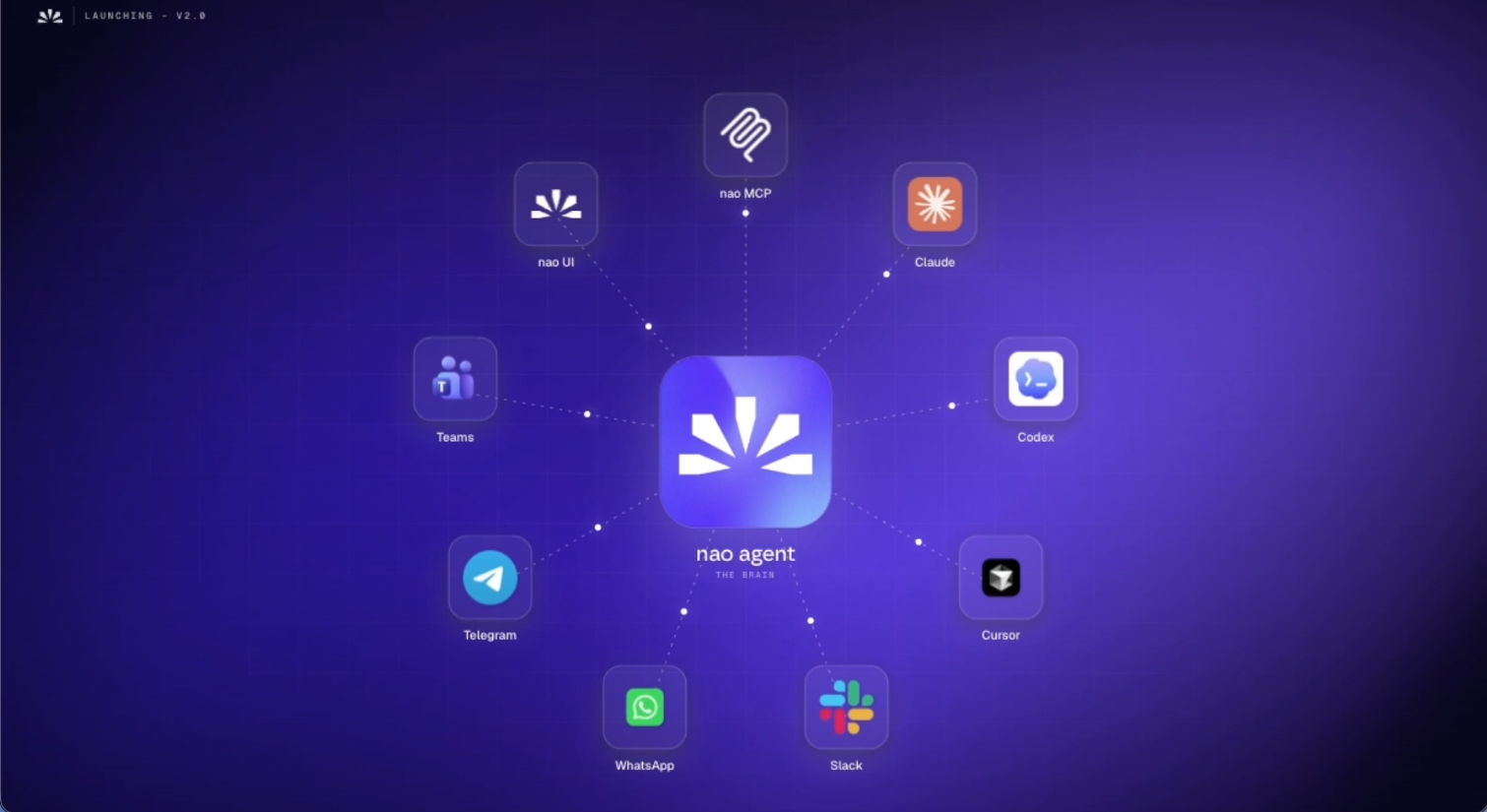
nao already supported Slack, Teams, WhatsApp, and Telegram. You could deploy the same agent to all four messaging platforms with the same context stack behind it.
What's new is the nao MCP - a Model Context Protocol server that exposes your analytics agent to any MCP-compatible tool. We're launching it tomorrow with a full technical deep-dive.
With the nao MCP, your company data brain extends beyond messaging into the tools where people build, code, write, and think. Claude, Cursor, Codex - any tool that speaks MCP can query your data brain directly. That's the last mile of headless: the data brain is not just where you talk, but where you work.
Stay tuned this week for more demo videos and feature announcements.
Try it
nao is fully open source. Apache 2.0. Self-host it, connect your warehouse, and deploy the agent to every surface your team uses.
Star us on GitHub: github.com/getnao/nao
Read the docs: docs.getnao.io
Or just ask your first question. Headless.
Related articles
product updates
We're launching the first Open Source Analytics Agent Builder
We're open sourcing nao — an analytics agent framework built on context engineering. Here's our vision for what comes after black-box BI.
product updates
Launching nao context recommendations
nao now audits its own usage and tells you exactly where your context is missing, wrong, or unclear - then opens the fix as a pull request in your context repo.
product updates
Launching nao automations
Schedule your nao analytics agents to run in the background. Recurring reports, conditional alerts, and a new Feed to track all agent activity.

Claire
For nao team