Looker Conversational Analytics, Data Agents and Data Apps
Looker Conversational Analytics, data agents and Data Apps reviewed: how Gemini in Looker works, its limits, and nao as the open source alternative.
27 November 2026
By Claire GouzeFounder @ naoLooker's AI is only as right as your LookML, and nobody tests it.
Looker Conversational Analytics is Google's chat-with-your-data feature for Looker, powered by Gemini. Business users ask a question in plain English, Gemini picks fields and filters from your LookML model, and Looker writes the SQL. Around it, Google adds data agents (shared, configured assistants), Looker Data Apps (agent-generated apps hosted in Looker) and LookML syncing into Knowledge Catalog for Gemini Enterprise. What it does not give your data team is a way to test the answers, a choice of model, or context beyond LookML. nao is the open source alternative: an analytics agent your data team builds, tests and monitors on any warehouse, with your dbt project as context.
This review is based on Google's documentation and announcements, our Looker comparison page, and what Looker users wrote this week.
Looker Conversational Analytics, data agents and Data Apps: what each one does
Each option comes with its limit:
- Conversational Analytics: a chat with one Explore at a time, available on Looker (Google Cloud core) and Looker (original). It reads your LookML field names, labels and descriptions, picks fields and filters, and lets Looker generate the SQL. A question that needs two Explores is out of reach.
- Data agents: connect up to five Explores and add authored context: a business glossary, a persona and custom instructions, shared across the organization. Five Explores is the ceiling, and the context is what someone typed into Looker.
- Conversational Analytics for Looker Embedded: the same natural language experience inside your own customer-facing apps, powered by Gemini (Google Cloud). Gemini only.
- Looker Data Apps (preview): interactive web apps generated from natural language prompts, the Antigravity CLI or Claude Code, hosted inside Looker, inheriting LookML modeling, row-level security and access controls (Google Cloud). Even Google builds them with a coding agent; they still only run in Looker.
- LookML in Knowledge Catalog (GA): LookML models, Explores, views and join logic sync into Knowledge Catalog, which grounds Gemini Enterprise and custom agents, with lineage from BigQuery tables to Looker dashboard tiles (Google Cloud). Your definitions become context for Google's agents, in Google's catalog.
How Looker Conversational Analytics works
The LookML model is the source of truth. Gemini does not write SQL against your warehouse: it maps the question to fields, filters and an Explore, and Looker compiles the query from LookML. That is the strength (joins and measures are defined once) and the limit (anything not modeled in LookML does not exist for the agent).
So the answer is exactly as right as the definition behind it. A Looker user posted this week that sales ops reported 11.8M of Q4 pipeline while the Looker dashboard said 10.6M. Finding why meant going through the LookML and two dbt models, until they found a stage filter someone had put in a macro. "That took most of an afternoon, and it's the third time this quarter someone has questioned a number" (r/Looker). An AI layer on that LookML gives the same 10.6M, faster, with more confidence.
Copies make it worse. One team copied revenue from their dbt metric into a semantic view for their warehouse agent; dbt later got a refunds fix, the copy didn't, and "the agent and the Looker dashboard are 3% apart and both are right" (r/snowflake). Looker's AI adds one more copy: LookML next to dbt.
How much does Looker AI cost?
No amounts here: they change, check Google's pricing. What to know before signing:
- Looker is sales-led. In our experience you can't trial it and deploy it on your own, which is also why we could not test its AI hands-on (nao vs Looker).
- Google says it will bill Gemini usage above each instance's token allocation from February 1, 2027. The more people use the AI, the less predictable the bill.
- The hidden cost is maintenance: every definition your dbt project already has must be written and kept in sync in LookML.
Looker AI limitations
- One Explore per conversation, five per data agent. Questions that cross subject areas, or touch tables nobody exposed in an Explore, get no answer or the wrong one.
- Context stops at LookML. Your dbt docs, business rules, Notion pages and analysis procedures stay outside, except what someone retypes as data agent instructions. There is no dbt sync: teams on dbt maintain two semantic layers.
- Gemini only. You can't bring the model your company already pays for, or switch when a better one ships.
- Nobody tests the answers. We found no evaluation framework in Google's docs to measure how often an answer is right before opening it to users.
- Monitoring is not observability. Admins see engagement and token usage in System Activity, and query review is still in preview. That tells you the agent is used, not whether it was right.
- Your agent lives in Google's products. Answers show up in Looker, Looker Embedded or Gemini Enterprise.
- Few data teams run their agent on it. Among the data teams we talk to every week, we haven't seen one use Looker as its analytics agent.
Should you build your analytics agent on Looker?
Not if your data team wants to own it. It is lock-in by design:
- Your context lives in LookML, readable by Looker and, through Knowledge Catalog, by Google's agents.
- Your model is Gemini. Google decides when it changes.
- Your reach is five Explores. The agent knows what was curated for it, not your warehouse.
- Your quality is unmeasured. Without tests, the first person to check a number is the executive who questions it.
Can nao replace Looker?
For most of what people open Looker for, yes: check KPIs, filter by region or plan, get the weekly report, ask the question no dashboard answers.
| What you use Looker for | How nao does it |
|---|---|
| Dashboards on governed metrics | Stories: KPIs, charts, tabs and filters built by the agent from one request, live refresh |
| LookML as the source of truth | Your dbt project, semantic layer and LookML files as context files in your repo |
| Conversational Analytics | Chat on your whole warehouse context, in the web app, Slack, Teams or Claude |
| Scheduled deliveries and alerts | Automations: scheduled reports and conditional alerts by email or Slack |
| Data apps for business teams | Custom stories: interactive data apps and slide decks in your brand |
| Trusting the numbers | nao test on your key questions, before and after every context change |
Stories instead of dashboards
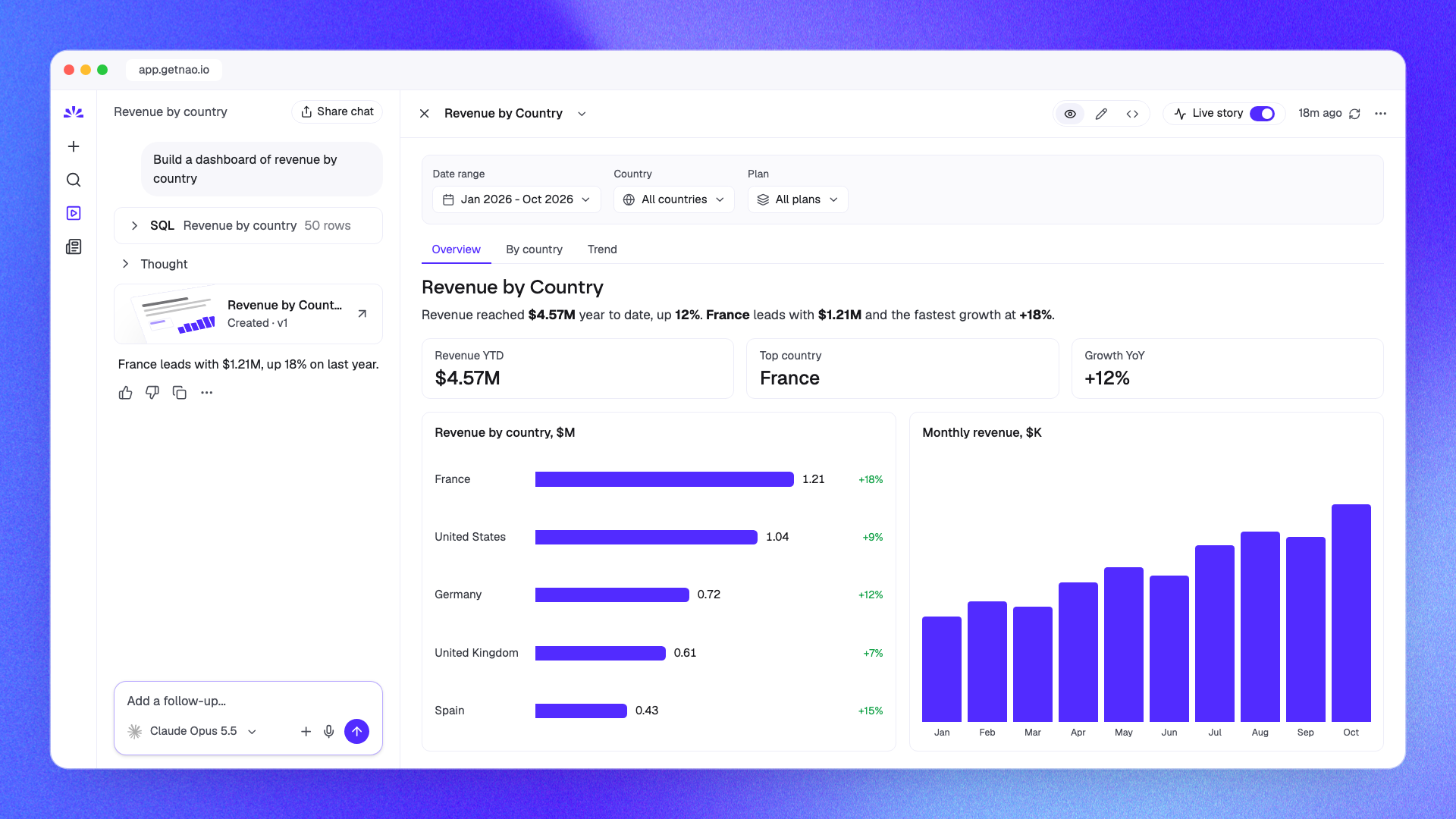
Ask "Build a dashboard of revenue by country" and the agent writes the SQL, runs it on your warehouse and builds a story with KPIs, charts, tabs and filters. Turn on Live story and it refreshes on a schedule, with every save versioned.
Chat on all your context, everywhere
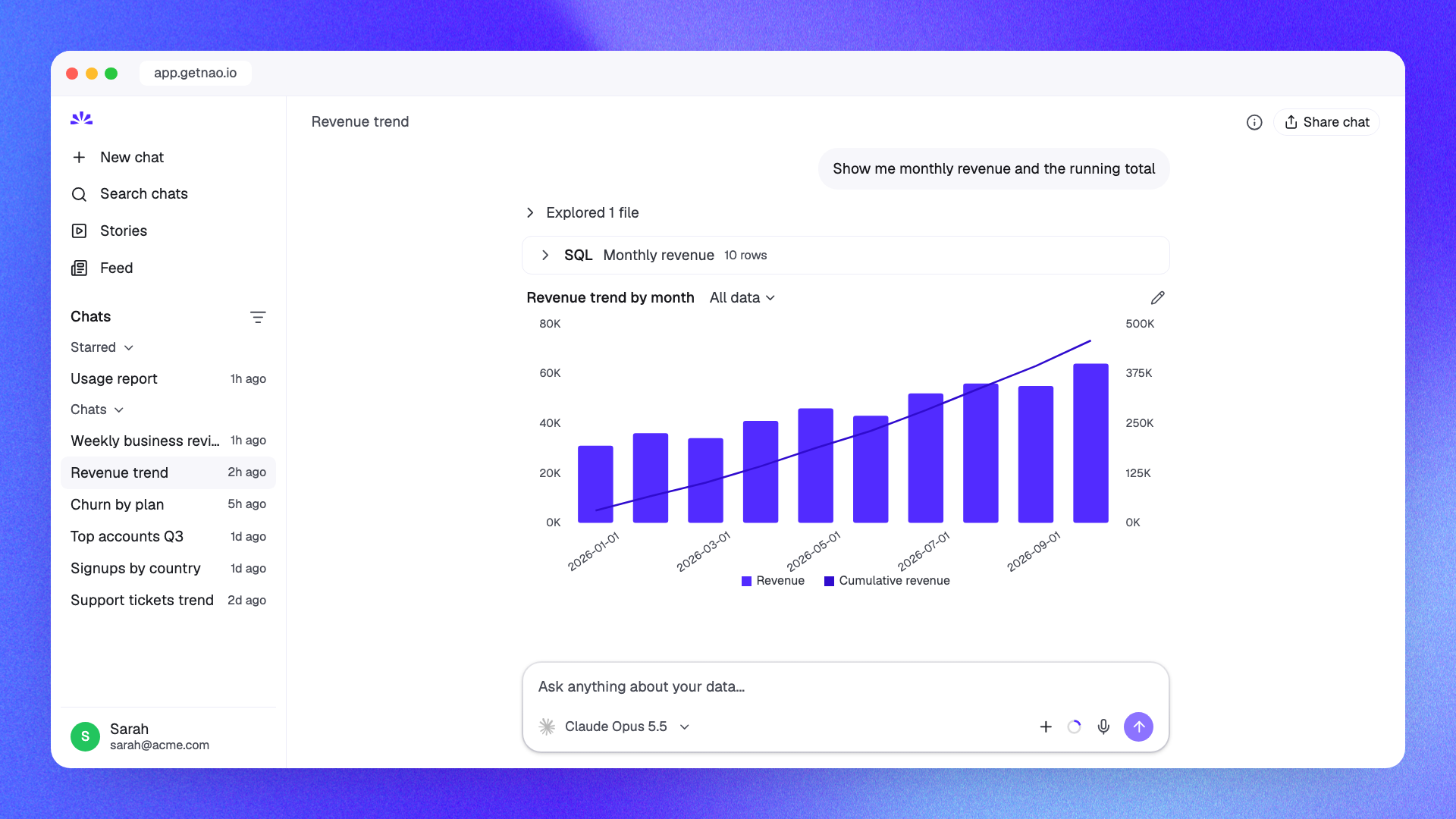
In nao, anyone asks in plain English and gets the SQL, the chart and the answer in one thread: in the nao web app, Slack, Microsoft Teams, or in Claude, ChatGPT and Cursor through the nao MCP app. The agent is not capped at a few Explores: it reads the context your data team built, from RULES.md to dbt docs and skills.
Keep your LookML, test against your Looker numbers
You don't throw LookML away. Add your LookML (or dbt MetricFlow) files to the context as files, the way our semantic layer guide describes. Then turn the Looker queries you already trust into tests: nao's create-context-tests skill asks for trusted source-of-truth queries (Looker, dashboards) and turns each one into a test, and nao test checks the agent returns the same numbers. The 11.8M vs 10.6M kind of gap becomes a failing test, not an afternoon.
nao vs Looker AI
nao is open source (Apache 2.0). Self-host it or run it on nao Cloud, bring your own LLM, read every line of the agent.
| Looker AI (Conversational Analytics, data agents) | nao | |
|---|---|---|
| License | Proprietary, sales-led | Open source, Apache 2.0 |
| LLM | Gemini only | Yours: Claude, GPT, Gemini, Mistral, Bedrock, Ollama, switch any time |
| Context | LookML, plus glossary and instructions typed in Looker | Files in your repo: schemas, dbt docs, RULES.md, semantic layer, skills |
| Scope | One Explore per chat, five per data agent | The tables and docs your data team put in context |
| Interface | Looker, Looker Embedded, Gemini Enterprise | nao web app, Slack, Microsoft Teams, Claude, ChatGPT and Cursor through the MCP app |
| Evaluation | None found in Google's docs | nao test on your own questions |
| Observability | Engagement and token usage, query review in preview | Every question logged with its SQL, thumbs up / down, Chats Replay, context recommendations |
| Hosting | Google Cloud | nao Cloud or self-hosted with Docker |
Test it like code
pip install nao-core,nao init, connect your warehouse (database docs) andnao sync. Or sign up on nao Cloud and do it from the UI.- Add your dbt repo, your LookML and your business rules in
RULES.md, following our context engineering guide. - Write 20 to 40 real questions with their reference SQL, starting from your trusted Looker queries, and run
nao test. - Roll it out and watch real usage: when a user flags a wrong answer, click Save as test, fix the context, rerun the suite. Context recommendations point at the gaps you didn't think to test.
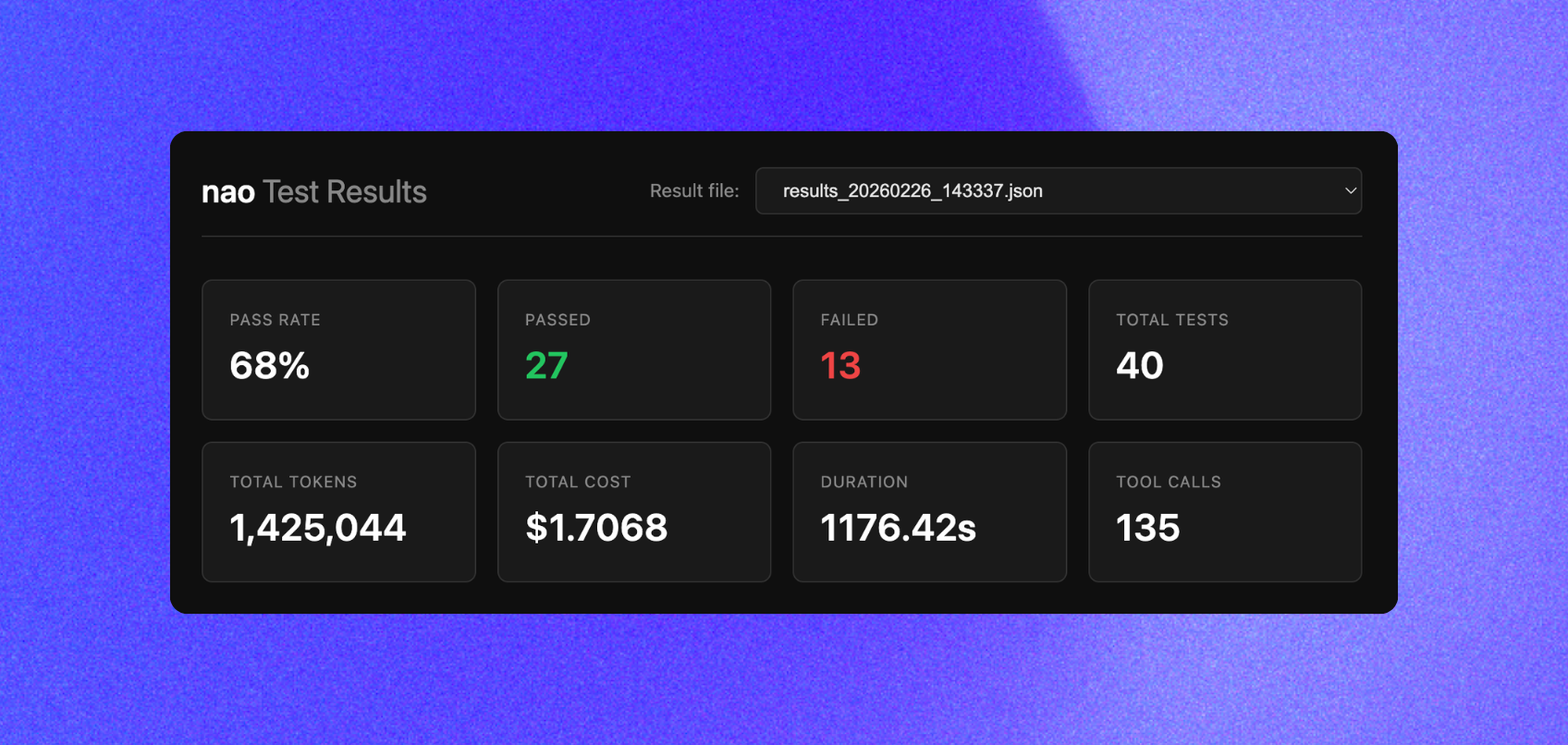
This loop took our own agent from 45% to 86% right answers. See how other tools did in our 20-tool benchmark, the rest of Google's agent stack in our BigQuery conversational analytics review, and the full method in the agentic analytics playbook.

Claire
For nao team
Frequently Asked Questions
Related articles
product updates
Launching nao agentic BI builder
Sign up on nao Cloud, connect your warehouse, add business context, and deploy your own agentic BI to the whole company from the nao UI. No CLI needed. Still open source.
Buyer's Guide
How to Choose Your First BI Tool: Top 3 Free Options
The 3 free BI tools companies adopt when they start their analytics journey, compared on features, pricing, setup and how far they scale.
Buyer's Guide
Tableau AI Features: Tableau Next, Pulse and Tableau Agent
Tableau Next, Pulse and Tableau Agent reviewed: how Tableau's AI works, its limits, and whether nao, open source, can replace a dashboarding tool like Tableau.